


Page 1 - Spotlight Issue 72
P. 1
Qingshan Campus‧April 2026


                                                                                                                        Issue72


                 Guiding Students into the Future
                 Guiding Students into the Future
                 Guiding Students into the Future
                 Guiding Students into the Future


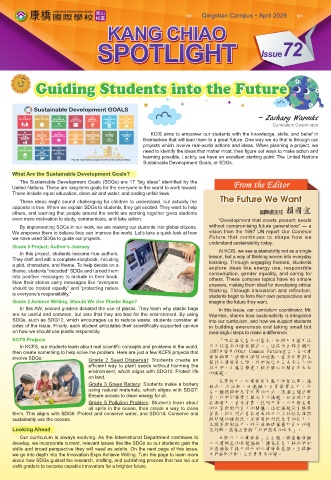
                Sustainable Development GOALS

            01      02     03      04      05     06      07                                                          ~ Zachary Warmke
          NO POVERTY  ZERO HUNGER  GOOD HEALTH   QUALITY  GENDER   CLEAN WATER   AFFORDABLE
                         AND WELL-BEING   EDUCATION  EQUALITY  AND   AND
                                                                                                                             Curriculum Coordinator
                                                SANITATION  CLEAN ENERGY
            08      09     10      11      12     13      14
         DECENT WORK   INDUSTRY,   REDUCED   SUSTAINABLE   RESPONSIBLE   CLIMATE   LIFE BELOW   KCIS aims to empower our students with the knowledge, skills, and belief in
           AND
          ECONOMIC   INNOVATION   INEQUALITIES  CITIES   CONSUMPTION   ACTION  WATER
                   AND
                                          AND
                                  AND
          GROWTH  INFRASTRUCTURE  COMMUNITIES  PRODUCTION         themselves that will lead them to a great future. One way we do that is through our
                                                                  projects which involve real-world actions and ideas. When planning a project, we
            15      16     17
         LIFE ON LAND   PEACE, JUSTICE PARTNERSHIPS               need to identify the ideas that matter most, then figure out ways to make action and
                    AND
                           FOR
                  STRONG   THE GOALS
                 INSTITUTIONS                                     learning possible. Luckily, we have an excellent starting point: The United Nations
                                  From the United Nations,Department of Economic and Social Affairs
                                                                  Sustainable Development Goals, or SDGs.
       What Are the Sustainable Development Goals?
                                                                                                           From the Editor
          The Sustainable Development Goals (SDGs) are 17 “big ideas” identified by the                    From the Editor
       United Nations. These are long-term goals for the everyone in the world to work toward.
       These include equal education, clean air and water, and ending unfair laws.
                                                                                                     The Future We Want
          These ideas might sound challenging for children to understand, but actually the           The Future We Want
       opposite is true. When we explain SDGs to students, they get excited. They want to help
       others, and learning that people around the world are working together gives students                           國際處主任 賴國宜
       even more motivation to study, communicate, and take action.                                 “Development that meets present needs
          By implementing SDGs in our work, we are making our students into global citizens.    without compromising future generations” — a
       We empower them to believe they can improve the world. Let’s take a quick look at how    vision from the 1987 UN report Our Common
       we have used SDGs to guide our projects.                                                 Future that continues to shape how we
                                                                                                understand sustainability today.
       Grade 5 Project: Author’s Journey
          In this project, students become true authors.                                            At KCIS, we see sustainability not as a single
       They draft and edit a complete storybook, including                                      lesson, but a way of thinking woven into everyday
       a plot, characters, and theme. To help decide on a                                       learning. Through engaging themes, students
       theme, students “decoded” SDGs and turned them                                           explore ideas like energy use, responsible
                                                                                                consumption, gender equality, and caring for
       into positive messages to include in their book.                                         others. These complex topics have no simple
       Now their stories carry messages like “everyone                                          answers, making them ideal for developing critical
       should be treated equally” and “protecting nature                                        thinking. Through discussion and reflection,
       is everyone’s responsibility.”                                                           students begin to form their own perspectives and
       Grade 2 Achieve Writing: Should We Use Plastic Bags?                                     imagine the future they want.
          In this AW, second graders debated the use of plastic. They learn why plastic bags        In this issue, our curriculum coordinator, Mr.
       are so useful and common, but also that they are bad for the environment. By using       Warmke, shares how sustainability is integrated
       SDGs, such as SDG12, which encourages us to reduce waste, students consider all          into our curriculum, and how we support students
       sides of the issue. Finally, each student articulates their scientifically-supported opinion   in building awareness and taking small but
       on how we should use plastic responsibly.                                                meaningful steps to make a difference.
       KCFS Projects                                                                                「既能滿足當代的需求,同時又不損及後
          In KCFS, our students learn about real scientific concepts and problems in the world,   代子孫需求的發展模式。」這段來自聯合國於
       then create something to help solve the problem. Here are just a few KCFS projects that   1987年發布的Our  Common  Future宣言,為永續
       involve SDGs:                     Grade 2 Seed Dispersal: Students create an             發展揭開了清晰而深刻的起點。當全世界都在

                                         efficient way to plant seeds without harming the       探討永續發展之際,我們相信身為未來主人的
                                                                                                孩子們,也應有機會了解並關心攸關自身未來
                                         environment, which aligns with SDG15: Protect life     的議題。
                                         on land.
                                                                                                    在學校中,永續發展不應只停留在單一課
                                         Grade 3 Green Battery: Students make a battery         程或一次活動,而應融入日常教學之中,成
                                         using natural materials, which aligns with SDG7:       為一種理解與思考世界的方式。透過主題式學
                                         Ensure access to clean energy for all.                 習,我們引導學生關注多元議題,如全球化與
                                         Grade 5 Pollution Problem: Students learn about        能源運用、責任消費、性別平等,以及對差異
                                         oil spills in the ocean, then create a way to clean    的包容與對所有人的關懷。這些議題沒有標準
       them. This aligns with SDG6: Protect and conserve water, and SDG14: Conserve and         答案,卻也因此更能培養孩子以系統性思維理
       sustainably use the oceans.                                                              解問題的複雜性,並發展批判性思考的能力。
                                                                                                在探索與對話中,孩子逐漸建構屬於自己的價
       Looking Ahead                                                                            值判斷,想像並實踐「我們想要的未來」。
          Our curriculum is always evolving. As the International Department continues to           本期以「永續發展」為主題,精選數個融
       develop, we incorporate current, relevant issues like the SDGs so our students gain the   入永續概念的專題課程,讓家長更了解我們如
       skills and broad perspective they will need as adults. On the next page of this issue,   何透過教育提升孩子的永續發展意識,並鼓勵
       we go into depth into the Innovation Expo Achieve Writing. Turn the page to learn more   他們採取行動,為世界帶來改變。
       about how SDGs guided the research, drafting, and publishing process that has led our
       sixth graders to become capable innovators for a brighter future.

